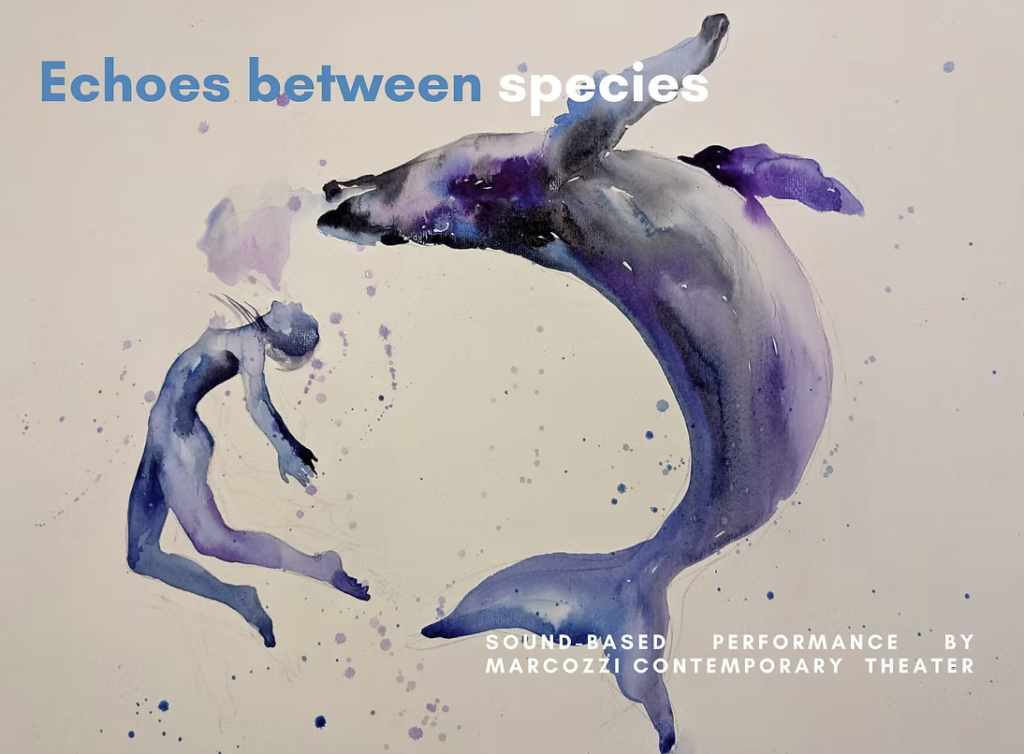
Echoes Between Species
Credits
Una performance sonora di Marcozzi Contemporary Theater e M.A.R.E. Movimento Artistico Ricerca Ecologica.
Performance: Daniela Marcozzi & Stefano Ciardi
Ideazione: Daniela Marcozzi
Sviluppo dell’ideazione, creazione, drammaturgia: Daniela Marcozzi, Stefano Ciardi, Francesca Sarah Toich
Musiche originali e live electronics: Stefano Ciardi
Voce fuori campo: Francesca S. Toich
Sguardo esterno e facilitatrici del processo: Cecile Rossant, Francesca S. Toich
Costumi: Susanne Kasper
Manifesto: Nino Eliashvili
Supervisione scientifica: Laura Pintore & Joelle Montesano, biologhe marine, esperte di megafauna del Mediterraneo per il WWF.
Ringraziamenti
Si ringraziano il Teatro di Lari (Pisa, Italia) e la Compagnia Teatrale Sartoria Caronte per la residenza artistica (residenza RAT); il PARC (Performing arts research center) di Firenze per la residenza artistica e il riscontro, l’Expedition Metropolis Theater per la residenza artistica e per aver mostrato il lavoro in corso nell’ambito del NN Festival Aprile 2026.
“I have often wondered what is easier to explore: the depths of the ocean or the depths of the human heart!”
(Comte de Lautréamont)
Identity is relational. This is the central point of the performance. Identity is not univocal, but a dynamic exchange with the environment and with other individuals of our own and other species. To unwind this core-fact, the performance draws inspiration from the acoustic identity of dolphins and other cetaceans in the ocean.
Let’s focus for now on dolphins, and consider two of their strategies for orientation, hunting, and socializing: echolocation and the signature whistle.
Dolphins emit ultrasonic clicks from their heads and listen to the echoes returning from the surroundings. These echoes indicate their position, what is around them, what it is made of, the presence of other living organisms, their velocity and trajectory: it’s a strategy for orientation and hunting. Through these clicks, dolphins build in their brain a sonic map of their surroundings, perceiving space, matter, and even the internal structures of other living beings and can “see” until 30 cm under the sea-bed. They literally see through!
Alongside echolocation, each dolphin develops a unique signature whistle, a melodic signal that says I am here. The baby dolphin learns the mother’s signature whistle, which, translated in human-like language, would mean: I am your mother – you are my son; it is a relational signal. It is a sound that expresses a relationship rather than a fixed identity.
During the first months of life, baby dolphins gradually transform the signature whistle learned from the mother to find their own personal one. They try many sounds and finally stabilize their own whistle, which is optimized to the environment in which they live and adapted to the group they belong to.
Dolphins use the signature whistle to announce themselves when they socialize and play. They also learn the whistles of others to call them back when they get lost or drift far from the pod—just as we do with human names.
The identity of cetaceans is largely acoustic. It emerges from a dynamic interaction with the environment, based on listening to how the world echoes them.
It is a kind of mirroring, as if to say: I know my place because I am echoed by the environment, and my identity is shaped by it and by the individuals I live with.
These refined systems of perception and communication are increasingly disrupted by anthropogenic underwater noise. Shipping, fishing, sonar, military activities and mineral extraction like drilling or deep-sea-mining saturate the ocean with different types and intensities of sounds, interfering with dolphins’ ability to orient, communicate, hunt, and survive.
Underwater noise literally prevents cetaceans from recognizing and orienting themselves in relation to the environment. It becomes like a wall between the animal and its surroundings, isolating it from others and, in extreme cases, leading to death.
Disoriented dolphins may also become trapped in fishing nets because they cannot perceive them—like crashing into an invisible wall.
Noise is for marine mammals what darkness is for human beings.
Devoted to a dual mission – scientific and oneiric – the performance alternates visions and poetic narratives with scientific information, through a dramaturgy that at times simply aims to inform the audience about the acoustic lives of cetaceans and their fragility due to noise pollution.
The performance explores this fragile and at the same time playful exchange of echoes between humans and cetaceans, where complex acoustic worlds collide with anthropogenic noise, transforming the ocean into a contested space of listening.
Echoes between Species fully dives in an illogical, subtle, mysterious and acoustic space of echoes between dolphins, human beings, noise, and vastness. It dives into a relationship between species, rooted beyond what we humanly call communication.
Dates and Tickets
+ 17.04.2026, h 20:00,
Expedition Metropolis Theater Ohlauerstr. 41 Berlin,
Work in Progress at Neue Narrative Festival
Buy Tickets