In our productions, the body, sound composition, and visual poetry become scenic action to tell the story of the relationship between human beings and the surrounding environment. Here you can find all M.A.R.E. performances currently in distribution, complete with artistic files, technical details, and ticket info.
Now airing
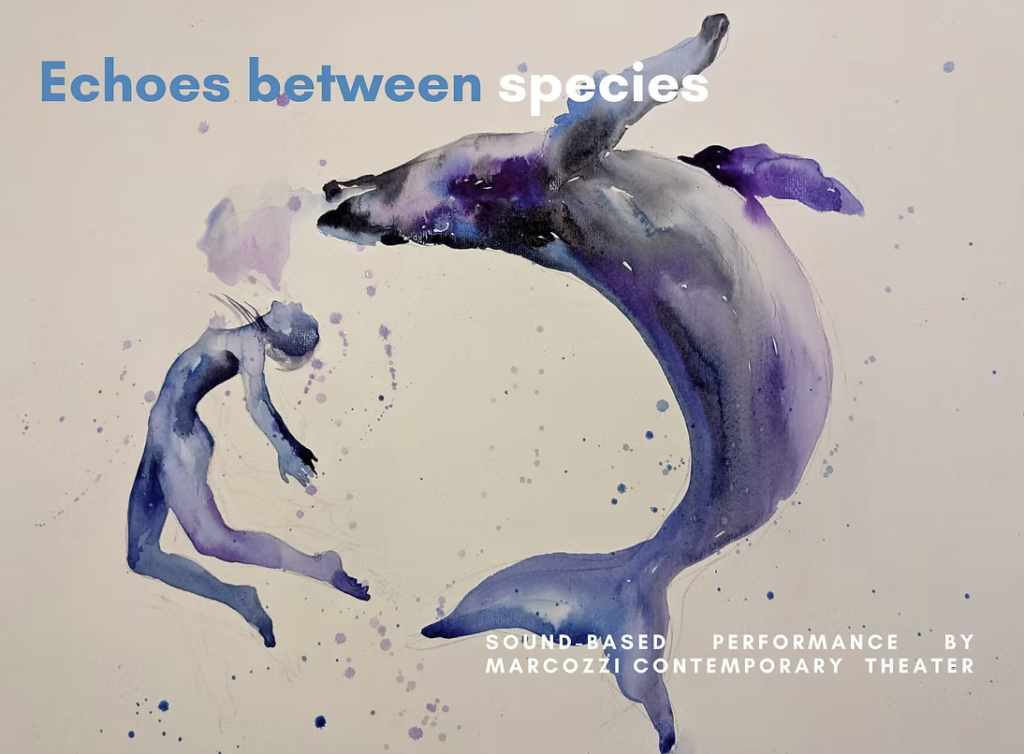
A sound-based performance by and with Daniela Marcozzi and Stefano Ciardi.
Read the description ↴
Upcoming Dates and Tickets ↴
Premiere
24.07.2026, h 21,
COLLINAREA FESTIVAL
Lari (Pisa), Italy
TICKETS
Description
“I have often wondered what is easier to explore: the depths of the ocean or the depths of the human heart!”
(Comte de Lautréamont)
Echo Between Species is a sound performance that explores identity as a relational, fluid, and shared phenomenon. Inspiring itself from the acoustic world of bottlenose dolphins, the performance invites the audience to immerse themselves in a listening space where the boundaries between human and non-human become porous, crossed by echoes, resonances, and interferences.
Between poetic narrative, soundscapes, and scientific research, the performance follows the tracks of a simple and radical question: who are we when we discover ourselves to be part of a web of relations that goes beyond our own species? In this imaginary dialogue between humans, dolphins, noise, and the ocean, listening becomes a tool to question perception, communication, and the way we construct our identity in the world.
Dedicated to a dual mission—both scientific and dreamlike—the performance alternates poetic visions and narratives with scientific data, through a dramaturgy that at times aims simply to inform the audience about the acoustic life of cetaceans and their fragility due to anthropogenic noise pollution.
“Echo Among Species” dives fully into an illogical, subtle, and mysterious acoustic space made of echoes between dolphins, humans, noise, and immensity. It immerses itself in an interspecies relationship, rooted far beyond what we humans call communication.
Let’s focus on dolphins for now and consider two of their strategies for orientation, hunting, and socialization: echolocation and the signature whistle.
Dolphins emit ultrasonic clicks from their heads and listen to the echoes returning from the surrounding environment. These echoes indicate their position, what is around them, what it is made of, the presence of other living organisms, their speed, and their trajectory: it is a strategy for orientation and hunting.
Through these clicks, dolphins construct a sound map of their surroundings within their brains, perceiving space, matter, and even the internal structures of other living beings—managing to “see” up to 30 cm below the seabed. They literally see right through us!
Along with echolocation, every dolphin develops a unique signature whistle, a melodic signal that says I am here. A dolphin calf learns the signature whistle of its mother, which, translated into human language, would mean: I am your mother – you are my child; it is a relational signal.
It is a sound that expresses a relationship rather than a fixed identity.
During their first months of life, dolphin calves gradually transform the signature whistle learned from their mother to find their own personal whistle. They experiment with many sounds and finally stabilize their own whistle, optimized for the environment they live in and adapted to the group they belong to.
Dolphins use the signature whistle to announce themselves when socializing and playing. They also learn the whistles of others to call them back when they get lost or move away from the pod—just like we do with human names.
The identity of cetaceans is largely acoustic. It emerges from a dynamic interaction with the environment, based on listening to how the world sends back their echo.It is a sort of mirroring, as if to say: I know my place because the environment returns an echo to me, and my identity is shaped by it and by the individuals I live with.
These refined systems of perception and communication are increasingly disrupted by underwater noise of anthropogenic origin. Maritime traffic, fishing, sonar, military activities, and resource extraction (such as drilling or deep-sea mining) saturate the ocean with sounds of various types and intensities, interfering with the dolphins’ ability to orient themselves, communicate, hunt, and survive.
Underwater noise literally prevents cetaceans from recognizing one another and orienting themselves in relation to the environment. It becomes like a wall between the animal and its surroundings, isolating it from others and, in extreme cases, leading to death.
Disoriented dolphins can also become trapped in fishing nets because they fail to perceive them—as if they were crashing into an invisible wall.
Noise is to marine mammals what darkness is to human beings.
Credits and Thanks
Production:
M.A.R.E. and Marcozzi Contemporary Theater
Concept:
Daniela Marcozzi
Concept Development, Creation, and Dramaturgy:
Daniela Marcozzi, Stefano Ciardi, Francesca Sarah Toich
Original Music and Live Electronics:
Stefano Ciardi
Voiceover:
Francesca S. Toich
Outside Eye and Process Facilitators:
Cecile Rossant, Francesca S. Toich
Costumes:
Susanne Kasper
Poster Design:
Nino Eliashvili
Scientific Supervision:
Laura Pintore & Joelle Montesano, marine biologists, Mediterranean megafauna experts for the WWF.
Special Thanks to: Expedition Metropolis Theater for the artistic residency and for showcasing the work-in-progress as part of the NN Festival, April 2026; Teatro di Lari (Pisa, Italy) and the Sartoria Caronte Theater Company for the artistic residency (RAT residency); PARC (Performing Arts Research Center) in Florence for the artistic residency and feedback;
Premiere
24.07.2026, h 21,
COLLINAREA FESTIVAL
Lari (Pisa), Italy
https://www.collinarea.it/
Date in aggiornamento
Work in Progress at Neue Narrative Festival
17.04.2026, h 20:00,
Expedition Metropolis Theater Ohlauerstr. 41 Berlin